
DIGINNOV provides innovation procurement consultancy based on the European Assistance for Innovation Procurement (EAFIP) methodology. We help public buyers apply it from needs assessment to post-contract follow-up. Pre-commercial procurement (PCP) can be suitable when meeting the need requires new research and development (R&D). Public procurement of innovative solutions (PPI) is a route for adopting innovative solutions that are ready or nearly ready for the market.
Six ways DIGINNOV supports innovation procurement *
Needs and requirements assessment
Work with users and buyers to prioritise unmet needs and define measurable outcomes and operational constraints.
Technology, IP and standards review
Review prior art and competing approaches, search relevant intellectual property records, and map regulatory, certification and interoperability requirements.
Business case and market engagement
Compare costs, benefits, timing and risks. Run an open market consultation to test assumptions and refine the case for investment.
Procurement strategy and tender preparation
Help choose a procurement route and develop the IPR and confidentiality strategy, functional requirements, evaluation criteria and draft tender documents.
Phased procurement and performance monitoring
Support the buyer during tender evaluation and, in a PCP, track competing suppliers’ milestones, test results and progression between phases.
Post-contract planning and follow-up
Review ongoing IPR and confidentiality obligations, capture lessons and consider standardisation and future deployment.
* Based on the EAFIP methodology. EAFIP Toolkit Module 2 · June 2026
How pre-commercial procurement works
In a pre-commercial procurement (PCP), a public buyer contracts several suppliers to develop competing solutions to an unmet need. After preparation and tendering, the suppliers work in parallel through design, prototyping and operational validation. The buyer assesses results against published criteria before deciding who advances.
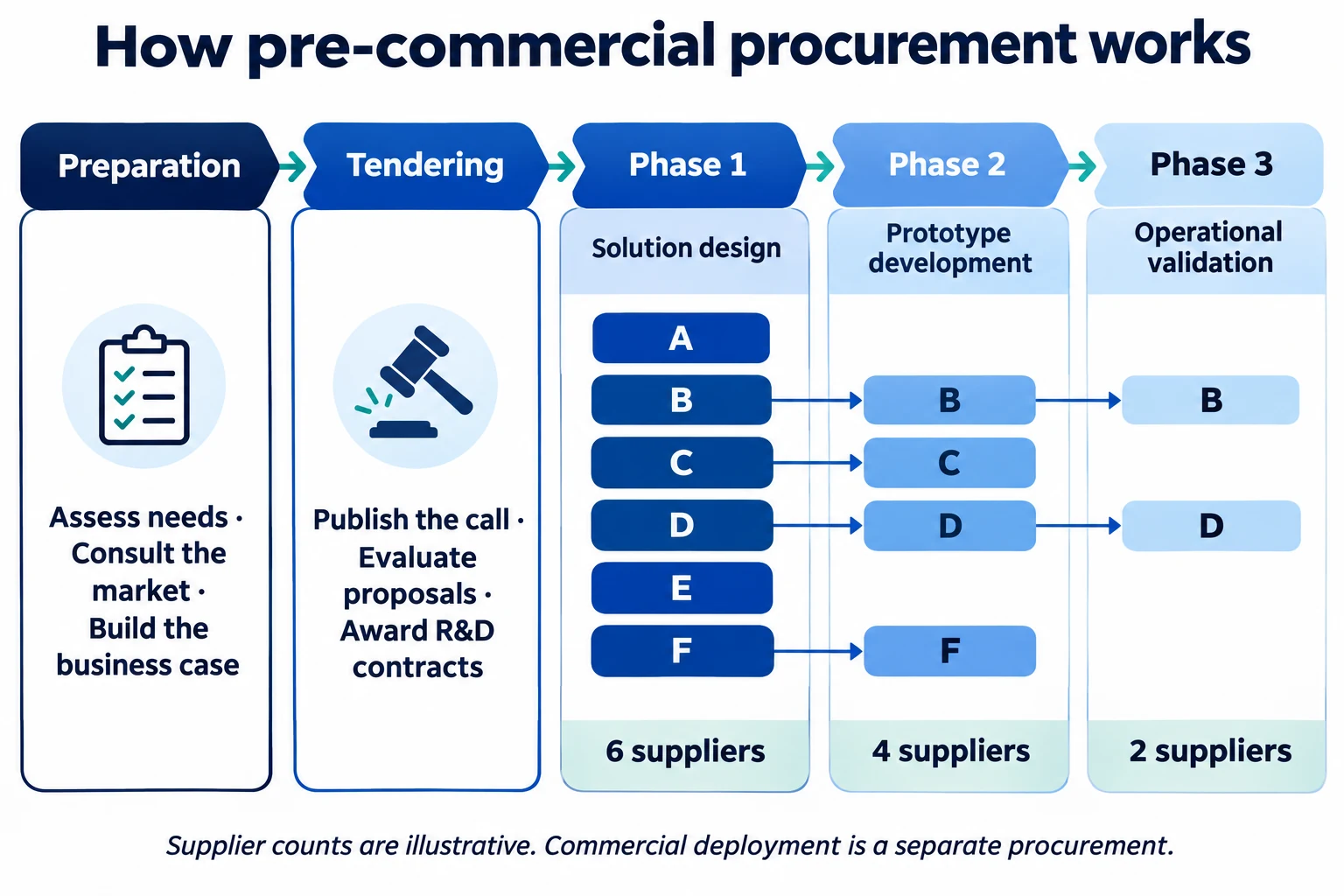
In the example, six suppliers start with solution design. After evaluation, four advance to prototype development. Two then go on to validate a limited series of first products or services in operational conditions. The arrows follow the same suppliers from one phase to the next. Open the full-size figure.
Preparation
Assess needs, review the state of the art, consult the market and prepare the business case and evaluation approach.
Tendering
Publish the call for tenders, assess proposals and award R&D contracts to competing suppliers.
Phase 1 · Solution design
Explore and design alternative solutions.
Phase 2 · Prototype development
Develop and test prototypes.
Phase 3 · Operational validation
Develop and test a limited series of first products or services.
DIGINNOV’s consultancy role
DIGINNOV provides independent consultancy on how to apply the EAFIP methodology. EAFIP is a European Commission initiative. This page summarises its guidance and should be read alongside the official toolkit. The contracting authority remains responsible for choosing the procedure, making procurement decisions and verifying the applicable legal requirements.